
The U.S. has defended itself with an all-volunteer force for 50 years. Relying on conscription during World War I and World War II and the early Cold War, Americans soured on the draft during the prolonged Vietnam War.
Running for president in 1968, Richard Nixon promised to end the draft and established the Gates Commission to assist in that purpose once elected. Congress allowed the draft law to expire in July 1973.
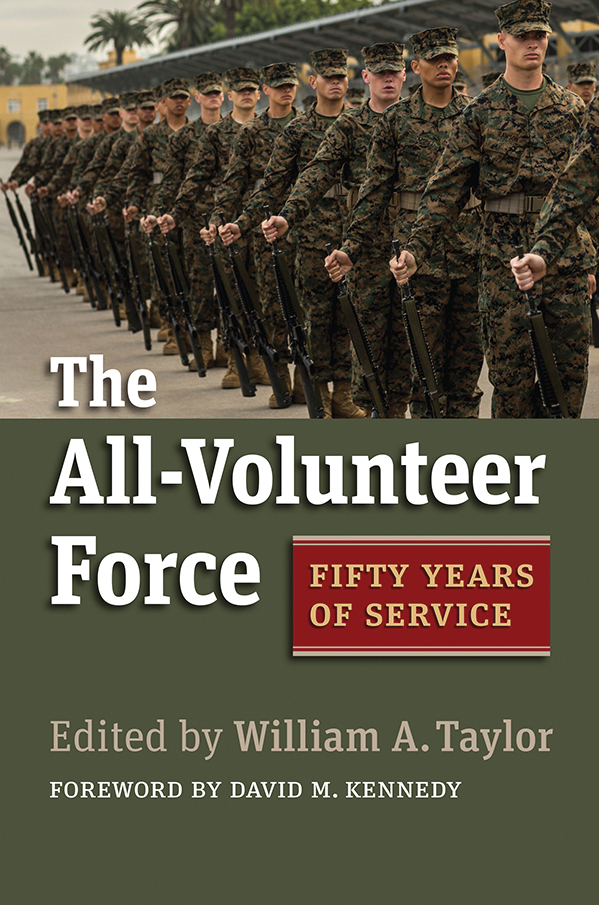 Recognizing this anniversary, William Taylor, author of Every Citizen a Soldier: The Campaign for Universal Military Training After World War II, has assembled this fine anthology, The All-Volunteer Force: Fifty Years of Service. Drawing on recognized experts, it addresses major facets of the all-volunteer force in four parts.
In Part One, “History,” Amy Rutenberg provides historical background. Then, Michael Gibbs and Timothy Perri underscore the role of economists in deciding upon an all-volunteer force. Taylor describes the deliberations of the Gates Commission, and Beth Bailey explores issues concerning race and diversity.
Shifting to Part Two, “Results,” Kara Dixon Vuic examines the roles of women. Jennifer Mittelstadt then describes the evolution of a “wrap-around welfare state” within the military as an incentive for retention and recruitment. Titus Firmin describes the all-volunteer force as firmly middle class, with the lowest socioeconomic quintile not qualifying for and the highest quintile not interested in military service.
In Part Three, “Challenges,” retired U.S. Army Reserve Maj. Gen. Dennis Laich ponders the long-term viability of the all-volunteer force, given a shrinking pool of eligible young people with smaller percentages inclined to military service. Lawrence Wilkerson opines that the all-volunteer force is too easy to use but not big enough to win major wars. Retired Maj. Gen. Jeffrey Phillips then discusses the force’s radically increased reliance on the reserve component.
“Implications” of the all-volunteer force include an emerging culture, explored by Adrian Lewis, wherein service is no longer an expectation of citizenship. Mark Cancian explores force structure, citing the reserve component, government civilians, capital assets and contractors as alternatives to regular forces. Marybeth Ulrich examines force demographics over time, discovering reasonable representativeness but a growing civil-military gap.
As is often the case with anthologies, transition from one essay to the next can be jarring. Taylor remediates this with a conclusion tying threads together and providing overarching commentary.
The all-volunteer force has enjoyed striking successes and faced troublesome challenges. Not ideal for all circumstances, it seems a best fit that will remain with us unless circumstances substantially change.
The essays are pithy, focused, informative and well documented. Almost 800 tightly written endnotes provide a treasure trove for those wanting to do more research. Taylor also provides a chronology and paragraph-length backgrounds of the contributing authors.
As excellent as this collection is, more attention to alliances and to the “standby draft” might improve it. Most strategic scenarios envision U.S. forces fighting alongside more numerous allies. This influences the size and composition of the all-volunteer force. If the force is too small for a big war, how would a resurrection of conscription work, and what are the plans for having one? Essays on these topics might render a future version of this volume even more comprehensive.
Taylor provides an invaluable service by gathering and publishing this outstanding volume. I strongly recommend it to anyone interested in the experience of our armed forces over the past 50 years. It provides a firm foundation to contemplate the evolution of these forces going forward.
To buy the book, visit https://kansaspress.ku.edu/9780700634811/.
Brig. Gen. John Brown, U.S. Army retired, served 33 years in the Army, with his last assignment as chief of military history at the U.S. Army Center of Military History. The author of Kevlar Legions: The Transformation of the United States Army, 1989–2005, he has a doctorate in history from Indiana University.