The Reserve Organization of America was the nation’s sole and exclusive supporter of the uniformed services’ reserve forces at a pivotal congressional hearing.
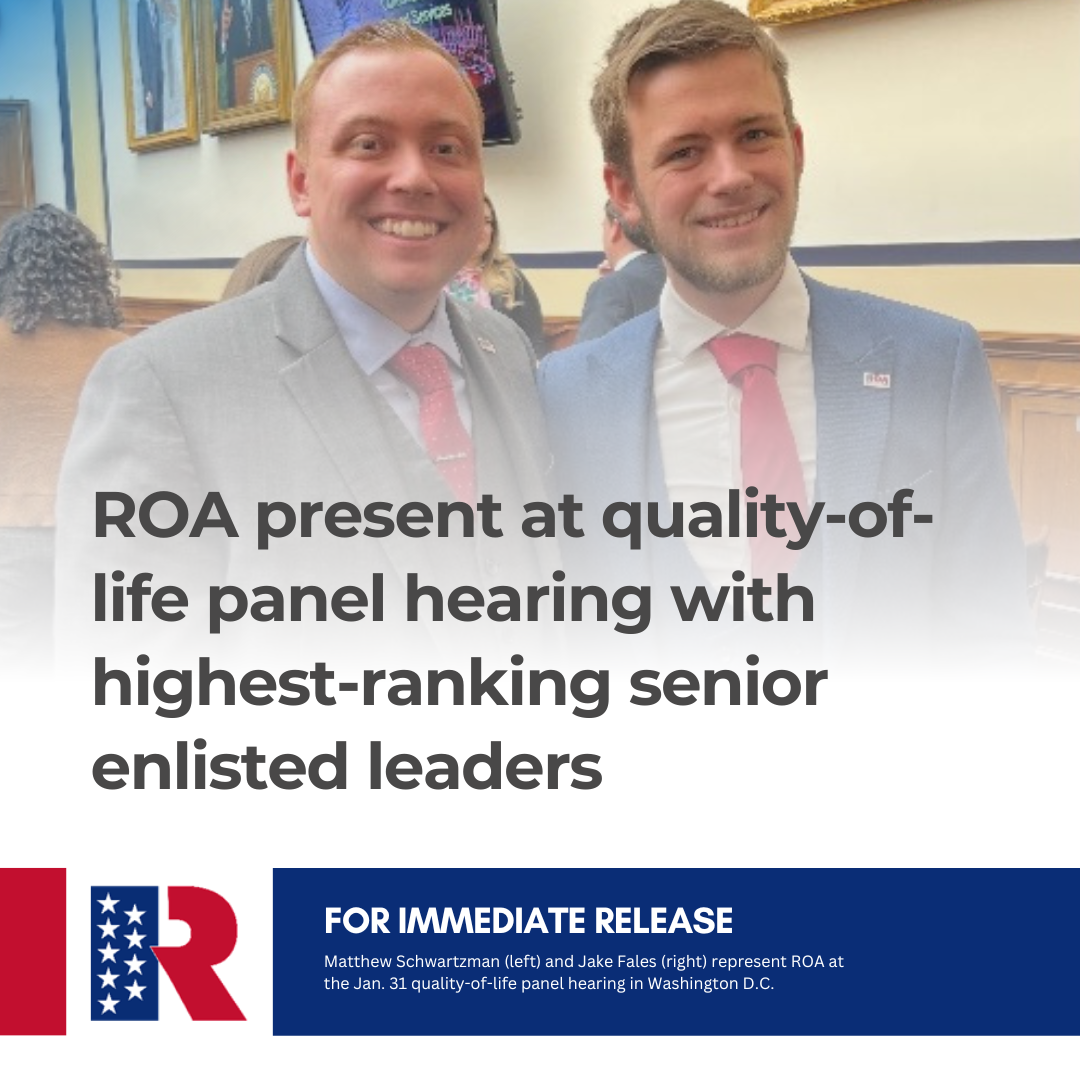
WASHINGTON, D.C. — The Reserve Organization of America was represented by legislation and military policy director Matthew Schwartzman and defense fellow Jake Fales at yesterday’s House armed services committee quality-of-life panel hearing at the Rayburn Office Building in Washington D.C.
The newest addition to ROA’s team, Fales described the experience as “really great” and “enlightening.”
The hearing featured testimony from the highest-ranking senior enlisted leaders of every armed force focused on the quality-of-life challenges facing today’s military. Each leader formally acknowledged and spoke to the important connection between quality-of-life and readiness.
Rep. James Moylan (Guam), an Army veteran, asked Army Sergeant Major Weimer about actions to improve quality-of-life for Reserve and National Guard members stationed in Guam.
“They have big responsibilities there… this unit [the Task Force Talon] must work outdoors in muddy fields and the hot sun,” said Rep. Moylan. “The conditions are more like a battlefield during peacetime. Members of the Task Force struggle to access programs such as space A flight which can boost morale.”
In response to the all-important question of “what can be done?” Sergeant Major Weimer told the congressman that he would be visiting Guam soon to get a “first-hand perspective with our National Guard teammates” on the issues impacting the members of Task Force Talon.
Revealingly, this was the only direct reference made to issues specifically impacting Reserve and National Guard service members and their families.
“Constituting more than forty percent of the Total Force, ROA believes that quality-of-life issues impacting reserve component service members and their families are worthy of their own hearing and consideration,” said ROA’s executive director Jeff Phillips. “Congress must seize the opportunity to support the reserve forces, those that serve in them, and their families.”
Just as the situation in Guam is, in many ways, unique to those in Guam, issues for the reserve components are unique to those serving in them and their families. In a ROA Up to the Minute Man Update recorded immediately after the hearing, Schwartzman stated his intention to follow up accordingly:
“In response [to this hearing], ROA is going to look to set up a meeting with panel and committee leadership to focus on the Reserve and National Guard quality-of-life issues that can help to enable uniformed services to meet their recruiting and retention goals,” said Schwartzman.
One example of legislation that would make a significant difference to the quality-of-life of drilling Reserve and National Guard members and their families is H.R.5844, the Savings for Servicemembers Act. Drill weekends are a non-negotiable requirement for reserve component service members that ensure readiness.
Reserve and National Guard service members may be eligible to deduct mileage and other travel expenses associated with drill weekends when they file their annual tax returns. Unfortunately, the eligibility changed in 2017 with Public Law No: 115-97, the Tax Cuts and Jobs Act.
Now, the deduction is only provided to those reserve component members who traveled more than 100 miles to their drilling location. Before the act, it was provided to those who traveled 50 miles or more.
As a result, the likelihood of deducting mileage and other travel expenses associated with drill weekends has been substantially reduced. Conversely, those still eligible are likely to receive substantial savings each year.
The Savings for Servicemembers Act, introduced by Rep. Trent Kelly (MS-01) and Rep. Derek Kilmer (WA-06), simply restores access to the deduction for reservists traveling 50 or more miles to their drilling location.
The need to codify this legislation is urgent and will not add one cent to the defense department’s budget. And unlike recent actions taken by the Pentagon to strengthen the economic security of service members and their families, this addresses an issue uniquely faced by those in the Reserve and National Guard and their families.
Read more about H.R.5844, the Savings for Servicemembers Act, here.
While the panel’s next steps are not yet clear, ROA will keep you informed as we move through this process together.