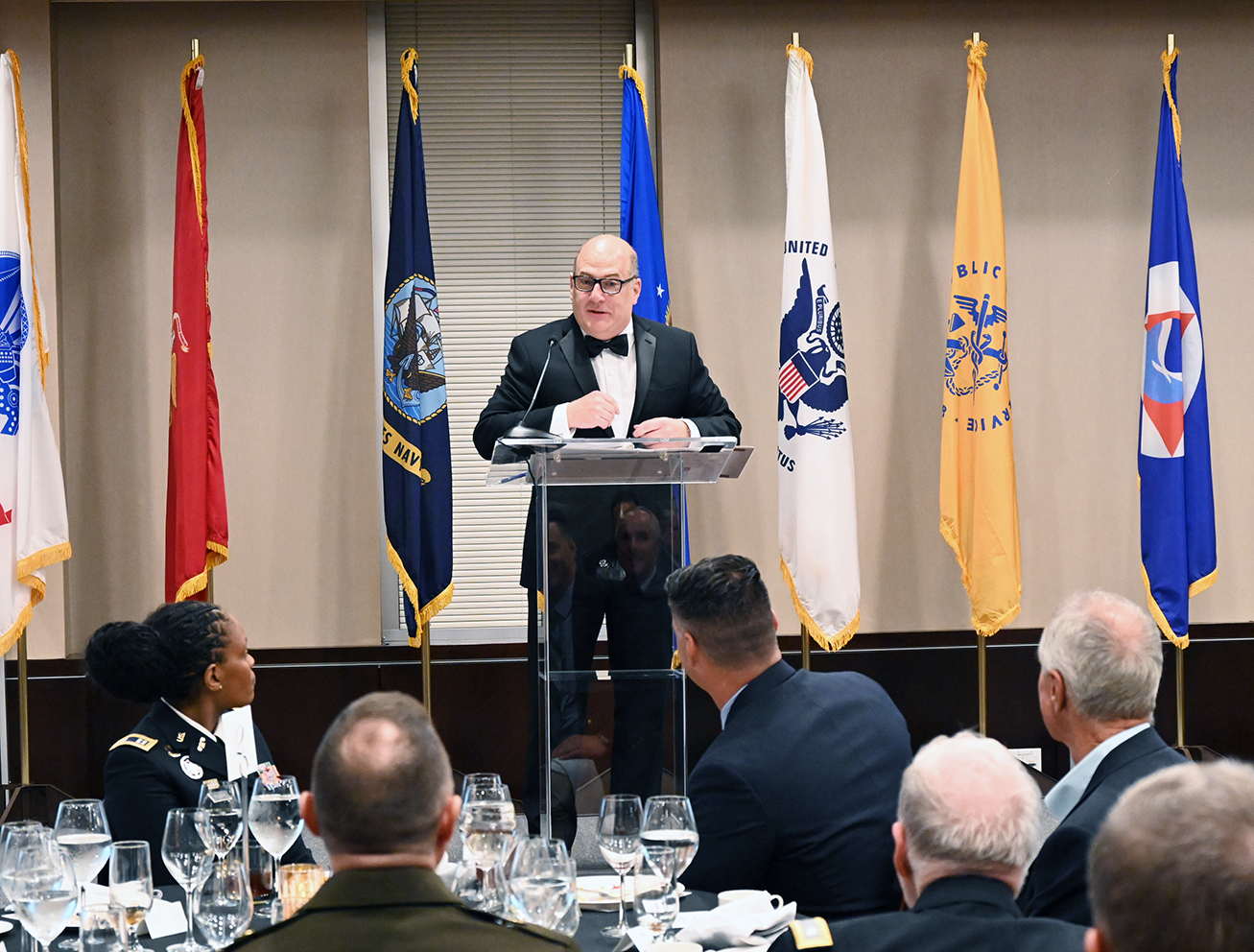
Assistant Secretary of Defense for Manpower and Reserve Affairs Ronald T. Keohane gave a comprehensive review of the Pentagon’s programs and initiatives in support of the operational reserve during the annual meeting banquet Oct. 5. (Photo by Alyssa Leavitt)
Addressing ROA members at the annual meeting banquet Oct. 5, Assistant Secretary of Defense for Manpower and Reserve Affairs Ronald T. Keohane gave a comprehensive review of the Pentagon’s programs and initiatives as dependence on the operational reserve grows within a national security environment characterized by the “acute threat” of Russia, and China’s “coercion, lawfare, information warfare, and aggressive actions . . . to achieve their objectives and destabilize the Indo-Pacific.”
Assistant Secretary Keohane described the role of the reserve components in “integrated deterrence,” the “coordination of every tool available to the Department, across services, components, the U.S. government and our allies and partners to ensure potential foes understand the folly of aggression.”
The Pentagon has developed a legislative package to tackle the duty status reform ROA has long championed, but has foundered year after year on the rocks of bureaucratic inertia and “it’s-just-too-tough-ism” in the executive branch and on Capitol Hill.
The secretary described a refinement of the power-projection platform model used to mobilize RC units and personnel. Called Mobilization and Force Generation Installation platforms, designated installations (such as Fort Riley, Kansas), “train and prepare active and reserve forces to deploy, and are vital to the Department’s planning for large scale mobilization.”
He described how establishing the MFGI at Fort Riley “required bringing an Alaska National Guard unit to serve as the post’s Mission Support Force – a unit that serves as the MFGI’s engine and coordinates post-mobilization processing and training. MFGIs also required doctors, dentists, and lawyers to give one last medical, dental, and legal check to our deploying Service members, so Fort Riley also brought in those specialties from Army Reserve units.”
Citing the importance of the RC’s advantage in accessing individuals with special skills, Keohane told ROA – holding its first-ever convention in our Minute Man Memorial Building, “Our Reserve Component Service members are uniquely positioned to support multi domain operations, or MDO, due to the immense talents and skills they gain daily working in the civilian sector. Your ranks are filled with cyber security professionals, airline pilots, professionals in the space and communications industries, journalists, content creators on social media, drone operators and software engineers-exactly the skills MDO requires to outmaneuver, outsmart and outmatch an opponent.”
“The key here is capturing that talent and ensuring our leaders leverage that talent to the greatest extent possible. The DoD is taking several steps to help that effort,” he said.
He spoke of an initiative named GigEagle, “developed by Reserve Component members for Reserve Component members, seeks to revolutionize how we find and utilize the tremendous talent within the RC. Gig Eagle is a talent matching platform that allows interested DoD Reservists and Guard members to build profiles that highlight their civilian expertise and find short-term work within the DoD.”
Assistant Secretary Keohane spoke of the importance of JROTC, progress on implementing the new DD Form 214-1, and of Pentagon’s initiatives to support the families he acknowledged as strained by the last two decades of activations and deployments, and the continuing national security environment. He spoke of childcare, “. . . and like childcare, [we] don’t believe a military spouse should have to decide between a fulfilling career and support to their Reserve Component spouse.”
The full transcript of Assistant Secretary Keohane’s remarks are here.
Key resources for Reserve Components
Military Teen Adventure Camps – open to any Service or component, free, with most camps held in the Summer, so a great way for a RC-connected teen to get away for a bit during the busiest time of training for the RC:
https://extension.purdue.edu/4-H/get-involved/military-teen-adventure-camps/index.html.
Military Spouse Employment Generally – the MySECO portal is open to any military-connected spouse to help find employment: https://myseco.militaryonesource.mil/portal.
Military Spouse Career Accelerator Pilot – this is the 12-week fellowship program, with paid employment fellowships open to military spouses of any component too. This is a great program and under-utilized by military spouses in the RC:
https://myseco.militaryonesource.mil/portal/article/military-spouse-career-accelerator-pilot.
Flexible Spending Accounts – these accounts, open to federal employees but only recently available to Title 10 AGR Service members and, starting next month, T32 AGR Service members, allow funds to be deposited into the account for dependent/child care. In the next open season in March 2025, T10 and T32 AGRs will be able to put funds away into a new type of account-Health Care Flexible Spending Accounts. Learn more: https://finred.usalearning.gov/Benefits#Flexible-Spending-Accounts.
GigEagle – GigEagle matches skilled talent from across the Department of Defense, solving tough challenges and transforming how we serve. Learn more: https://gigeagle.mil.