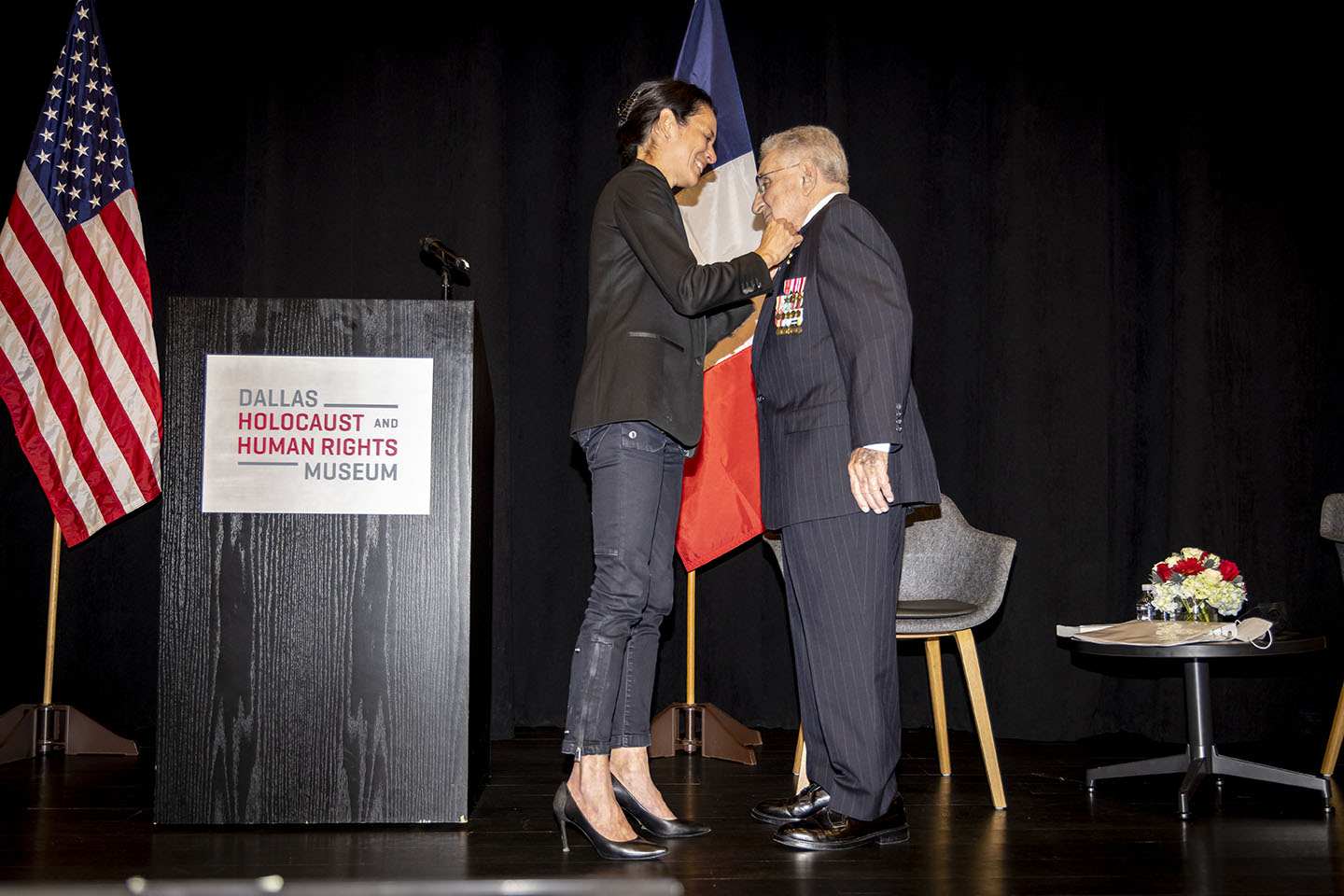
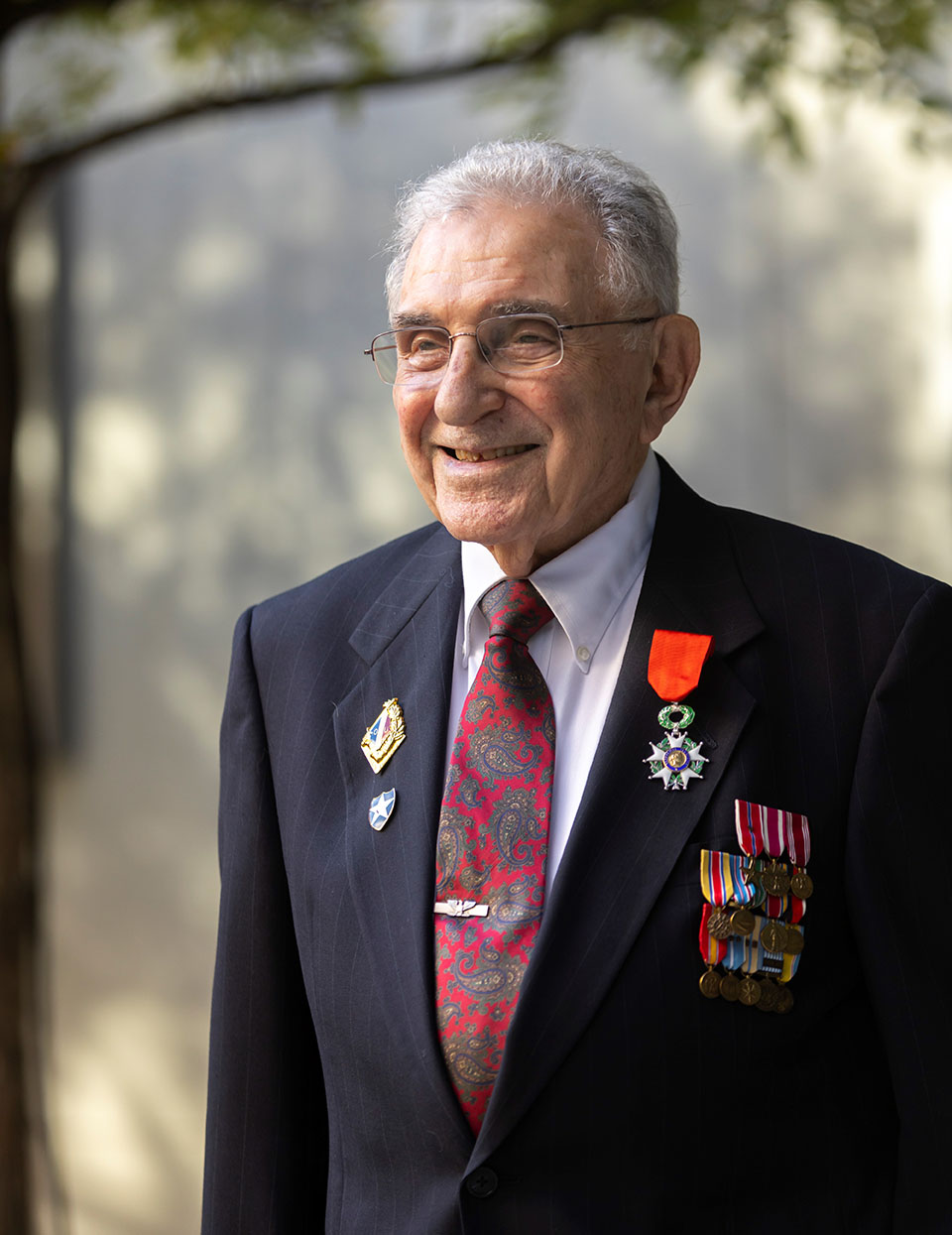
(Above) Retired U.S. Army Col. Ralph Hockley receiving Legion of Honor from Consul General of France
Valérie Baraban, Nov. 17, 2021. Photo by Dallas Holocaust and Human Rights Museum photographer Kim Leeson. (Below) Retired Col. Ralph Hockley, U.S. Army.
The “Passing West” of the Greatest Generation saw the passage onto hallowed memory Nov. 8 of retired U.S. Army Col. Ralph Martin Hockley, veteran of World War II and the Korean War, exemplar of the best in America, and longtime ROA member.
 “Losing a loved one hurts a lot. My husband, our father, grandfather and great-grandfather was also important to many other people. He left his deep impression on many lives,” Col. Hockley’s wife Carolyn wrote in his memorial program. The tribute was also written in French and German, two languages Ralph spoke fluently.
Born to a Jewish family in Karlsruhe, Germany, Oct. 17, 1925, Ralph grew up a European, educated classically and well. At nine, the Nazi scourge apparent, his family moved to Marseille, France.
At 14, as France fell into occupation, he worked in Marseille as an interpreter in his three languages for American Quakers there and as a link to the U.S. Consulate. Those contacts enabled his family to get visas and flee Europe for America in May 1941, a harrowing journey that included the release of his father from a German concentration camp and the crossing of the frigid Atlantic, then infested with U-boats.
I am reading the American correspondent Eric Sevareid’s superb 1946 autobiography, Not So Wild a Dream
. Sevareid was in France during the period the Hockley family was seeing the Nazi depredations against Jews that would become genocide; and as one must imagine, agonizing over what next to do.
Sevareid recounts how as a journalist he transitioned
from a “neutral” to a sobered realist; he returned to the States after the London Blitz of late 1940-early 1941, dismayed by the isolationism, ignorance of the war, and even pro-Nazi sentiment among his own people, shielded as they were from what he had experienced in France and England. Anyone who escaped occupied France or lived another day in besieged England had cheated death.
His family settled in New York, Ralph joined the U.S. military as soon as he could. “I could not wait to be part of the effort to bring to an end Hitler’s torture of Europe,” he wrote in his autobiography,
Freedom is not Free. He changed his name from Hockenheimer to Hockley. A nineteen-year-old American soldier, he stepped onto the continent in the closing weeks of the war, celebrating V-E Day on the Champs-Elysées and later visiting his French and German hometowns to thank neighbors who’d helped his family escape.
Using his fluency in French and German, as one of the Army’s “Ritchie Boys,
” many of them refugee Jewish soldier-linguists, he served in a more beneficent occupation than the one he’d fled, first as an intelligence special agent and then as a corporal in U.S. Army counterintelligence.
Ralph returned home in April 1946, his troopship passing the Statue of Liberty and a “mammoth” sign that read “Welcome Home – Well Done.”
“The obsession . . . to contribute to the disestablishment of the Hitler regime. . . had now been fulfilled. How close my immediate family and I had come to perishing from his madness. When it all began, I was a little German boy,” he wrote. “Twelve or thirteen years later, I was an American soldier and citizen, something that would otherwise never have happened.”
Next came Syracuse University on the GI Bill and a bachelor’s degree in political studies specializing in Russian area studies. Since returning from Germany, Ralph had stayed in the Army Reserve. Now came an opportunity to be commissioned. In May 1948, a year before graduating from Syracuse, he earned a commission as a second lieutenant in military intelligence.
While he had stepped into the second world war in its closing days, he entered the Korean War from its beginning. Now a field artillery officer with the 2nd Infantry Division, in August 1950 he saw combat in the
Battle of the Bowling Alley.
“Suddenly I saw a crouching enemy soldier coming toward us, holding an enormous old rifle with fixed bayonet,” he wrote. “[H]e was certainly no more than twenty-five feet downslope from me.” When his own carbine misfired, the young lieutenant “lost no time in grabbing my .45 automatic . . . and aimed it at the still advancing enemy. The .45 bullet stopped him cold. He had raised his rifle and was about to shoot when he got hit.”
In November, word reached his command that his father was gravely ill (he would die in June 1952); Ralph went home on emergency leave. He would return to war barely three months later. By his return home in December 1951, a first lieutenant, he had served in seven campaigns there, earning the Bronze Star with V-device for valor.
In his review of Ralph’s book appearing in the May 2022 issue of Reserve Voice Magazine
former ROA director of legislation and military policy Air Force Reserve Maj. Jonathan Sih wrote, “The defining moments of his military career were in the Korean War. The Korean War chapters . . . are detailed accounts of a soldier who was able
to see the war through so many different lenses: as an artillery forward observer, vehicle maintenance officer, back on the home front as he was spared from the Chinese advance in [autumn] 1950 due to a family emergency, and as a liaison officer
with French units fighting alongside the U.S. when he asked to return to Korea.
In November 2021, Colonel Hockley was awarded the highest French civilian award, the Legion d’ Honneur
, and inducted as a Knight of the Legion of Honor for his service and contributions to France, particularly as a U.S. artillery forward observer with the French UN battalion during the Korean War Battle of Heartbreak Ridge in 1951. Ralph was presented
this award at the Dallas Holocaust and Human Rights Museum by Consul General of France Valérie Baraban, who told Hockley he “could have taken advantage of the refuge offered to you by the United States, far from the barbarism which was unleashed
in Europe. But your courage and your sense of duty continued to guide you.”
The French Legion d’ Honneur requires French presidential approval; Colonel Hockley joins Audie Murphy, Sen. Daniel Inouye, and Gen. Colin Powell as other distinguished Americans inducted into knighthood.
After Korea, Ralph served out his regular Army time in military intelligence in Berlin. Returning home in 1955, he joined the Army Reserve. Moving to California, he met and married Eva Frankel, who was born in Berlin and escaped Europe as a child in 1941. He joined the federal Civil Service Commission as an investigator, retuning to West Germany and primarily focusing on East German activities during the early years of the Cold War. He would remain in West Germany nearly two decades, he and Eva raising there the couple’s children, Ralph and Denise.
A captain, Ralph saw at close hand the erection of the Berlin Wall. He was promoted to major in 1962, fulfilling his reserve commitments in West Germany. His promotion to lieutenant colonel came in 1969 and colonel five years later, serving as an individual mobilization designee for the deputy chief of counterintelligence, U.S. Army Europe and completing the Industrial College of the Armed Forces by correspondence. He retired from the Army in 1979.
Ralph, Eva, and their family returned to the States in 1981, settling in the San Francisco Bay area. There, in 1983, Eva died of heart trouble. Surmounting his devastation and urged on by his rabbi, Ralph rallied. He met Carolyn Harris later that year. They married in 1984, their new family now counting five children, with Carolyn bringing to the tribe Kris, Heidi, and Kirk (all Texas A&M grads).
Ralph was active in the Reserve Officers Association for decades; he had joined in 1948 as a second lieutenant and was president of the Frankfurt chapter during the Vietnam War. He was an active member of the ROA Department of Texas in Chapter 33 (Houston) and later in Chapter 18 (Dallas-Fort Worth). He led ROA’s support of the construction of the
Korean War Veterans Memorial on the National Mall. A true gentleman, he was known for his kind and generous temperament, and could be counted on to offer insights rich with the wisdom and perspective borne of his incomparable life experiences.
In addition to his other awards, Ralph earned a Meritorious Civilian Service Medal and the Department of the Army Meritorious Civilian Service Medal for his many years in a civilian capacity for the U.S. Army in Europe.
Col. Ralph Hockley led a full and impactful life founded on a legacy of service to the United States. To his dying day, he remained optimistic on his adopted country’s future and its role. “It behooves us Americans not to abuse our power,” he wrote in his book, “but to recognize our freedoms and good fortune and to help others to gain similar good fortune within the possibilities available to us.”
“What stands out in his story,” wrote former Undersecretary-General of the United Nations Jacques Paul Klein in his review of Ralph’s book, “is his indomitable spirit, humanism, and a basic decency which has been the hallmark of his life.” (A kindred spirit of Ralph and those like him who truly live life, Klein is
described as “A larger than life, cigar-smoking former U.S. State Department official and Air Force major-general who had previously led UN peacekeeping missions in Bosnia-Herzegovina and Croatia.”)
It is a paradox that the defining experience of Ralph’s adult life was the war he and others have called the “forgotten war.”
Yet in conquering his fears and serving his nation and his brothers there with valor, integrity, and distinction, he launched himself on a life certain to ensure that he shall himself never be forgotten.